 Yicai Machinery
1 / 1
| Specification | Details |
|---|---|
| Model | ECI-M002 |
| Process Type | Rotary die plastic cup thermoforming |
| Action Object | Plastic PP / PET |
| Scope of Application | Disposable plastic cup production |
| Mold Material |
• Upper and lower formwork/die body: 45# steel (forged and tempered) • Top and bottom edge: Cr12MOV • Stretch head: Nylon • Top cup rod/stretch rod: 45# steel (tempered) • Cup gall, cup cavity: Aluminum alloy |
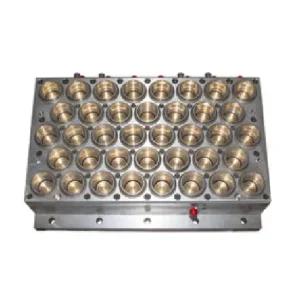
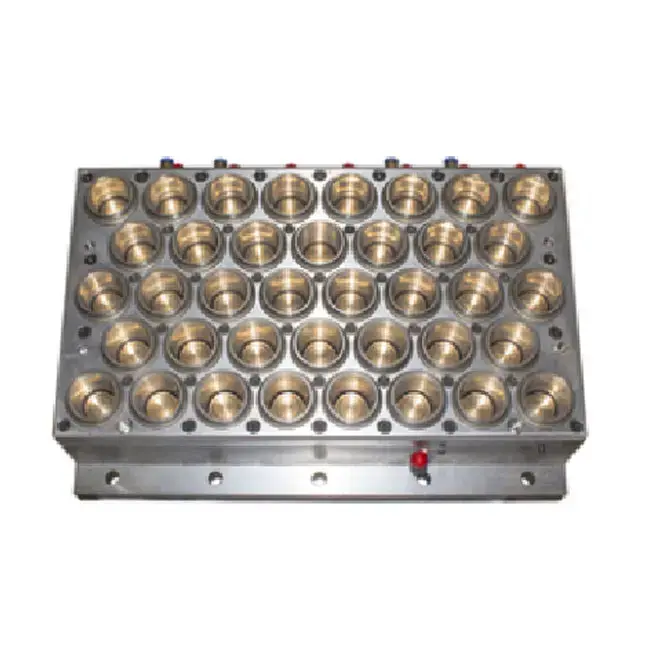
| Number of Cavity | 38 cavities |
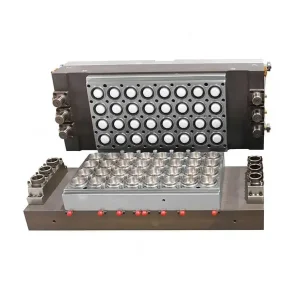
The disposable cup mold is typically designed as a multi-cavity mold. The M002 mold, with its 38 cavities, can produce over 38 cups in a single injection cycle, offering exceptional production efficiency.
Disposable cups often require specific aesthetic and dimensional accuracy, with various shapes available. Consequently, the mold demands high precision in manufacturing and processing.
Given the high-volume production of disposable cups, the mold must exhibit superior wear resistance and durability to ensure stable, long-term operation.
Disposable cup molds are designed for rapid replacement to accommodate the production of cups with different specifications and shapes.
The molds are capable of adapting to various types of plastic raw materials, enabling the production of cups made from different materials.
The rotary cup mold boasts a diverse array of application scenarios in the manufacturing of disposable plastic cups, primarily encompassing:
Disposable plastic cups are extensively utilized within the food and beverage sector, including fast food outlets, drink shops, and coffee houses, serving as containers for beverages, ice cream, and other food items.
The surge in takeout and delivery services has led to the widespread adoption of disposable plastic cups for packaging takeout beverages, such as bubble tea and fruit juices.
At major events, social gatherings, trade shows, and similar occasions, disposable plastic cups are commonly employed to dispense water and other beverages to attendees.
Disposable plastic cups are also staple products in retail environments like convenience stores and supermarkets, where they are sold directly to consumers.
In medical settings such as hospitals and clinics, disposable plastic cups are frequently used to hold medications, including liquid preparations and pills.
The operational steps for the cup mold encompass design, processing, assembly, debugging, mold testing, adjustment, and production. These steps require the collaboration of experienced technical personnel and precision processing equipment.
The first step involves formulating the mold design plan based on the design requirements of the disposable cup. This includes determining the cup's dimensions, shape, wall thickness, material, and other parameters. The mold structure, such as the number of cavities, is then designed according to these specifications.
Following the design plan, the mold is manufactured and processed using appropriate techniques and equipment.
The processed mold components, including the mold core, cavity, cooling system, ejector pins, and other parts, are assembled together.
After assembly, the mold undergoes debugging. This involves adjusting the mold's opening and closing actions, evaluating the cooling system's effectiveness, and ensuring the proper functioning of the ejector pins.
The mold is tested using a thermoforming machine to produce sample cups. The quality of the molded disposable cups is assessed, including dimensional accuracy and surface finish.
Based on the test results, the mold is fine-tuned. This may involve adjusting molding parameters or modifying the mold structure until the production requirements are fully met.
Once the mold is properly debugged and adjusted, it is ready for mass production of disposable plastic cups.
The ECI-M002 mold is built with 38 cavities, allowing it to produce over 38 plastic cups in a single injection and thermoforming cycle for optimal efficiency.
This rotary die thermoforming mold is designed to process plastic raw materials such as PP (polypropylene) and PET (polyethylene terephthalate).
The upper/lower formwork and die body are made of forged and tempered 45# steel. The top and bottom edges are Cr12MOV, the stretch head is nylon, the top cup/stretch rod is tempered 45# steel, and the cup gall and cavity are made of durable aluminum alloy.
The final cups are widely utilized in food and beverage outlets (like drink shops and coffee houses), takeout and delivery services, large-scale public events, retail supermarkets, and medical facilities.
The entire workflow consists of 7 major stages: Design (formulating dimensions and parameters), Processing (manufacturing parts), Assembly, Debugging (testing mechanical actions), Mold Testing (making sample cups), Adjustment (fine-tuning structure), and mass Production.